The Chrome browser features a minimalist UI which still manages to include most of the features of other browsers.
If you thought that the one thing the world needed was
another web browser, then I've got some good news for you: search giant Google has officially launched its own entry into the Internet Explorer-dominated market, dubbed
Chrome.
In keeping with almost every advanced feature Google brings out these days – from blog searching to e-mail – the browser is in open beta, but it's already getting plenty of attention. Built on an open-source platform – the source is already available from
Google Code – Chrome ticks a lot of boxes for your average web browser. Built around Apple's Webkit, the software has all the usual features including an in-built high-performance Javascript engine, tabbed browsing, and the increasingly popular private browsing mode dubbed “
incognito mode” to keep your late-night 'special time' private. Each tab is also created as a 'sandbox' environment, which – in theory – means that a crash in the browser caused by a coding problem on a website will only cause that individual page to close, not the entire browser.
Ars Technica's Ryan Paul has spent some time playing with Google's latest creation, and has come to the following conclusions: calling the user interface “
extremely minimalistic” and the overall layout “
reminiscent of Opera,” Paul says that the browser features “
nice visual flourishes” which “
improve usability without disrupting the flow of user interaction.” With just one day of experience, however, he has spotted a few bugs: unlike other browsers, Chrome doesn't seem to have anything in place for when you open a metric shedload of tabs; rather than overflowing onto a drop-down menu or making the tab bar slide across, the tabs simply shrink until the labels vanish.
While the interface could do with some work, the news is significantly better under the hood:
CNet reports that the browser bests the stable versions of both Firefox 3 and Internet Explorer 7 in the Acid3 web-standards tests, scoring 78 percent compared to Firefox's 71 and IE7's rather pathetic 14. The only final release browser to score higher is Opera, with 83 percent. While demonstrating Google's commendable commitment to open web standards, the comparison is a trifle unfair: after all, Chrome is still very much a beta product. When comparing development builds rather than release builds, the story is somewhat different: Chrome's 78 percent suddenly pales in comparison to Firefox 3.1 Beta 1 at 85 percent, is left in the dust by Opera's 91 percent, and the deathblow is dealt by Apple's Safari 4 Developer Preview which scores a mindblowing 100 percent on the Acid3 test.
Javascript support is also included in the beta build of Chrome – well, it's a de facto requirement these days – via Google's own
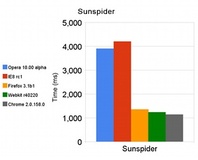
V8 engine, which is again open-source. Scoring well in system load and speed tests, it's clear that whatever Chrome's other shortcomings are, Javascript performance is unlikely to be among them.
Available for download
now, the Chrome browser is going to be an interesting one to watch – coming, as it does, from the world's most successful Internet company.
Have any of you already tried Chrome, and if so what were your impressions? Do you think Google is well positioned in the market to make a go of its browser, or is this release just likely to fragment an already divided marketplace? Share your thoughts over in
the forums.

(i understand it's beta, but still, currently it's just a faster IE7 with better search functionalities, and feels clean and cleap)
I especially noticed it on pages that used stuff like JavaScript/AJAX to pull content on the fly, was almost instant.
But to echo wuyanxu's comments, it does need more customisation and add-ons for me to replace Firefox3.
I think the base for this product is fantastic and with the community behind it testing the pants off it and submitting bug reports and page load errors with great ease, I think this can be a hit browser in a few months.
It's not functional enough to replace your main browser yet so FF is still the main choice for the enthusiast. But given time to iron out the flaws (as is the point at the mo) this should be something good.
It seems to render everything absolutely fine too which makes my life easier.
I think from now on, ie6 is just going to have to be forgotten.
Hopefully with both this and FF being open source, we'll see some quick cross-migration of features between the two.
- Google Analytics doesn't work with Chrome (*smack - ouch*)
- it uses some of the IE config boxes (look at the proxy config section)
- i believe that DNS prefetching being default-enabled will not make it feasible for large corporates (that and the lack of controlling it via tools like AD).
- Java is like a cest pool of bad security and it's inherently slow... they might have it all buckled up, but then, what happens to the speed and the security once plugins arrive?
- I firmly believe that this browser is not meant to conquer the PC market... being written in JAVA, i have the suspicion that the minimalist look, the lack of Aero integration, etc point towards (you guessed it) ANDROID (google open source phone platform)...
The speed of fetching AJAX data is impressive, but i SWEAR it's prefetching doing that... clever algorythms that prefetch content (most AJAX is really just urls that are stored somewhere on the source page and then requested, meaning that with clever parsing, you could quite possibly get those urls and load them up already while the user is still checking out how to navigate)...e.g. it's no faster when i do an AJAX post to this forum, as it's reliant on my input.
One big thing I dislike is that the Ctrl scroll to increase the size of the text doesn't so it like FF3 does, with FF3 I have the bit home page enlarged so it's easier to read and takes the full width of my monitor.
I prefer a web browser a tad slower and enjoy more functionality (there is not even a bookmark organizer!). And no add-ons or plug-ins! AT least Opera had a Mozilla plug-in emulator system when it was released.
Firefox for me, thank you.
Needs a few more configuration options, but I might start using it more. Does it have mouse gestures? I forgot to check on my PC.
11.1 You retain copyright and any other rights that you already hold in Content that you submit, post or display on or through the Services. By submitting, posting or displaying the content, you give Google a perpetual, irrevocable, worldwide, royalty-free and non-exclusive licence to reproduce, adapt, modify, translate, publish, publicly perform, publicly display and distribute any Content that you submit, post or display on or through the Services. This licence is for the sole purpose of enabling Google to display, distribute and promote the Services and may be revoked for certain Services as defined in the Additional Terms of those Services.
To clarify: 'Services' includes Chrome (see 1.1), and 'Content' includes 'data files, written text, computer software, music, audio files or other sounds, photographs, videos or other images' (see 8.1).
In other words, any data you use in conjunction with Chrome, and which you hold the copyright in, they are automatically given a licence to use as they please, including copying it and distributing it, provided it falls within the ambit of 'promoting the Services'.
http://tapthehive.com/discuss/This_Post_Not_Made_In_Chrome_Google_s_EULA_Sucks
they own everything you post, no thankyou.
------------------------------------------------
Google Chrome isn't officially out yet, but security researchers have already picked the browser apart to discover a security vulnerability.
The WebKit engine used inside Chrome leaves it vulnerable to the infamous Safari carpetbombing flaw, security researcher Aviv Raff warns. The flaw stems from a combination of a vulnerability in Apple Safari WebKit and a Java security bug, security blogger Ryan Naraine reports.
As a result Windows users of the beta software might be tricked into downloading malicious files onto their desktop. Raff has published a harmless proof-of-concept exploit in order to illustrate his concerns.
Apple patched the vulnerability with Safari v3.1.2, but the underlying software behind Chrome is based on older code, hence the vulnerability.
Security watchers warn further vulnerabilities are bound to arise. Against this many are praising the speed and built-in security features of the browser. Chrome features built-in sandboxing for each tab, anti-phishing technology and a privacy (ie smut-surfing) mode.
------------------------------------------------------
off El Reg
Unless you're using Chrome to access Google Docs to edit some mission critical top secret documents, who cares? For personal browsing, it's irrelevant - I don't care if Google reproduces, modifies, translates etc. this post to their heart's content. As if they'd want to.
So here's the thing - this is a public beta of open source software that they are giving away for free. Don't like the licence? Don't install it.
Still I'll have to wait for the real thing to decide if this is going to replace my trusty FF... don't think so.
I like how in the EULA, they reserve the right to publicly perform this post. :D
However, as expected, my normal mouse works in both directions...
As a photographer and artist, I care quite a bit. If I used Google's Chrome browser to upload some of my work to Photobucket or Flickr, Google would be able to grab my photo and use it to their heart's content, without my permission. Although it can be argued that I gave permission by agreeing to the EULA, I don't like the idea of Google potentially taking my work. Sorry, but if Google wants to use my art in their ads, I expect fair compensation.
However, I do agree with you:
At any rate, it looks like word has spread and Google is backtracking a bit:
Google edits Chrome EULA
-monkey
:( May I have some of what you're smoking please?
Java - Security is actually very good (feel free to post any recent exploits to back up your claim, otherwise I call bullshit) and any version in the last few years is actually pretty damm fast. Not quite C/C++ speeds, but they have optimised it well and it comes down to the quality of the developer writing the code. I think you may have meant Javascript, which is totally different language and runtime to Java, and is where the new V8 engine comes in, and that is smokin' fast in Chrome!
AJAX - typically means Javascript + Xml (or JSON) using asynchronous (non-blocking) communication using the XmlHttpRequest API. It's just a neat way to avoid reloading a whole page when you only want to change a part of the page. Ironically, Microsoft actually came up with this. So...faster Javascript engine = faster AJAX, no voodoo going on.
Chrome - Is NOT written in Java, it's mostly written in C++, I'm looking at the source code as I type this.
Chrome - Is MEANT to be cross-platform, so Aero integration will (probably) never be 100%
Android - Uses the same layout/HTML/DOM engine as Chrome (Webkit's WebCore), so what?
Perhaps you've confused the Java environment developed to create Android applications (via Eclipse plugin, etc) with Chrome, but either way, please educate yourself some more before spouting such rubbish.
Same here. On a Dell Vostro 1500 w/Vista64. Tres bizarre.
Edit: Just noticed that if I double click a word in a text box and try to type over it, it does nothing at all.
Until Google fix the rendering engine, can't say I'll be using it nor beta testing. The interface I do like and I think they have got it spot on.
http://www.pcworld.com/businesscenter/article/150776/critical_vulnerability_patched_in_googles_chrome.html
I had 3 Chrome windows open, each with multiple tabs. One of the tabs locked up and crashed, and it took down all 3 browser windows along with the tabs.
At least if Firefox 3 crashes it offers to reload all the pages you had opened previously. Chrome offered nothing after the crash.
google chrome vulnerabilities